

3 Ohio State faculty named fellows of National Academy of Inventors
Engineering professors, Nobel Prize-winning physicist are among 2024 class

Three professors at The Ohio State University have been elected as members of the National Academy of Inventors 2024 class of fellows.
The newest NAI fellows from Ohio State are Joseph Heremans, professor of mechanical and aerospace engineering and an Ohio Eminent Scholar in Nanotechnology, and two retired professors: 2023 Nobel Laureate Pierre Agostini, professor emeritus of physics, and Longya Xu, who recently retired as professor of electrical and computer engineering after more than 30 years on the faculty.
The NAI Fellowship is the highest professional distinction awarded solely to inventors. The 2024 class comprises 170 researchers from 135 research universities, governmental and nonprofit research institutions worldwide. This year’s selection of Heremans, Agostini and Xu brings the number of Ohio State NAI fellows to 21.
“The work done by Ohio State’s newest NAI fellows demonstrates the breadth and depth of research and innovation expertise that can be found at Ohio State,” said Peter Mohler, executive vice president, enterprise for research, innovation and knowledge. “Their research continues to positively impact people’s lives, and I’m pleased that the National Academy of Inventors is recognizing their efforts.”
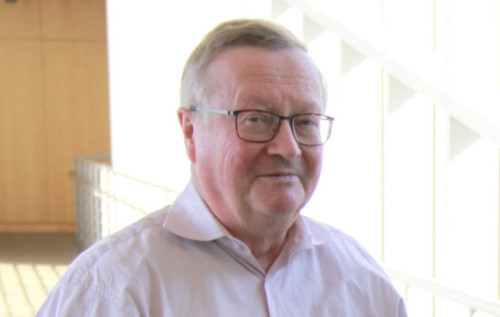
Heremans joined the Ohio State faculty in 2005 after spending over 20 years as an industry scientist, primarily at the General Motors Research Labs. He holds more than 40 U.S. patents, many dating to his work with GM.
Two families of patents led to commercialization: highly sensitive and tunable infrared lasers initially designed to analyze car exhaust gases that were manufactured by a German company and used to analyze isotope separation, and a set of magnetic sensors used in car engines for crankshaft and camshaft position sensing.
“This was a highly successful product that was in production for 10 years at a rate up to 2.6 million per year,” said Heremans, also a professor of materials science and engineering and physics. “All GM V6 and V8 engines had them at one time. They were gradually replaced by other sensors – technology eventually becomes obsolete.”
Heremans also has had a role in two startup companies. The first, focused on thermoelectric materials for waste heat recovery from car exhaust, was purchased by a company that manufactures automotive heating and cooling systems. He is also secretary and co-founder of Goniotech LLC, founded in 2019 to make devices for military applications.
More recently, he has applied for U.S. patents related to his work on thermoelectric materials; heat switches based on two distinct technologies, magnetic fields and electrical fields; and heat sensors, many of which are of interest to the U.S. Department of Defense.
Heremans was one of 11 university scientists named to the 2024 class of the Vannevar Bush Faculty Fellowship, the DOD’s flagship single-investigator award for basic research. He is the first Ohio State faculty member to be selected for the fellowship.
He is also a member of the National Academy of Engineering, and a fellow of the American Association for the Advancement of Science and of the American Physical Society.
“Here at Ohio State, the goal is to graduate students and do research and contribute to knowledge. I try in an academic setting to emphasize the fundamentals – but the applications are always there,” he said. “There’s a clear split between the fundamental part and the applied part, and it is nice to be recognized from the applied side.”
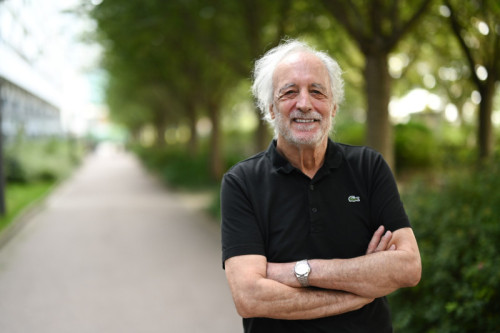
Agostini and two of his colleagues were recognized in 2023 by the Royal Swedish Academy of Sciences “for experimental methods that generate attosecond pulses of light for the study of electron dynamics in matter.” The scientists created techniques to capture electrons using pulses of light that last just an attosecond – one quintillionth of a second.
The Nobel Prize committee said Agostini and his fellow winners “have given humanity new tools for exploring the world of electrons inside atoms and molecules … (and) have demonstrated a way to create extremely short pulses of light that can be used to measure the rapid processes in which electrons move or change energy.”
Agostini joined the Ohio State physics faculty in 2005 after he retired from French institutions. He visited the Columbus campus in March, meeting with students and delivering a lecture.
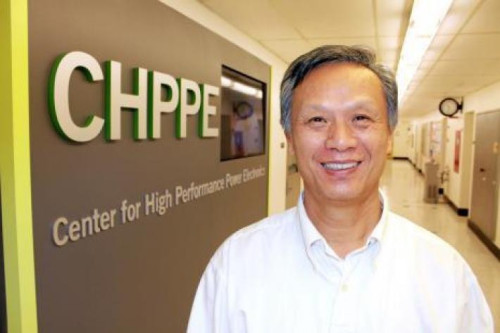
Xu was the founding director of Ohio State’s Center for High Performance Power Electronics, established in 2010 to focus on the commercialization of semiconductors for electrical power handling in the military and civil aircraft industry.
His research and teaching interests included the dynamics and optimized design of special electrical machines and power converters for variable-speed systems, the application of advanced control theory and digital signal processors for motion control, and distributed power systems in super-high-speed operations. He has served as a consultant to industry leaders including Raytheon, Boeing, Honeywell, GE Aviation, U.S. Wind Power, General Motors and Ford, among others.
An IEEE Fellow and recipient of IEEE’s Nikola Tesla Award in 2018, Xu also was named to the National Academy of Engineers in 2023.
The 2024 class of fellows will be honored at the NAI Annual Meeting on June 26, 2025, in Atlanta, Georgia.
