


AI Fluency Forum brings Ohio State community together to brainstorm, solve problems
Event fosters collaboration among subject matter experts, AI specialists

|
Chris Bournea Ohio State News |
The AI Fluency Forum brought together Ohio State faculty, graduate teaching associates, postdoctoral researchers and staff at the Ohio Union last week.
Presented by the Office of Academic Affairs, the forum supported the university’s AI Fluency initiative, said Shereen Agrawal, executive director of the Center for Software Innovation. Starting this year, the initiative embeds AI education into the undergraduate curriculum, preparing students to use AI tools, as well as understand, question and innovate with them.
“We are going to hit those challenges at scale with the brightest minds, the breadth and depth of talent to be able to think about these things and to figure out how we can, together, solve them,” she said. “How do we accelerate our own collaboration around what’s working, what’s not working? How are we going to adjust?”
The forum was also designed to foster collaboration among Ohio State faculty and staff to explore new ways to use AI in the classroom and address challenges that the technology presents, said Executive Vice President and Provost Ravi V. Bellamkonda.
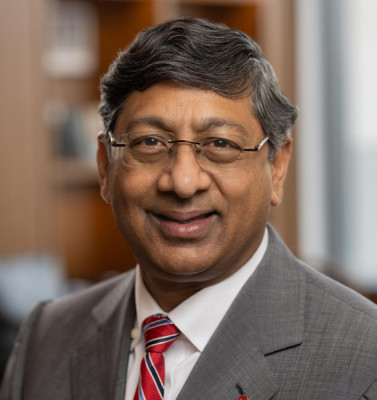 “Our bet at Ohio State is that we, as a community of scholars, will answer that question locally. And the university will do all it can to provide the scaffolding support to go on that journey,” he said. “Critical thinking, analytical rigor, judgment, ethical bearing, all of those things we have to inculcate. And we’ll figure this out in each field.”
Throughout the forum, faculty and staff made presentations and participated in panel discussions on teaching AI and its field applications, utilizing AI to enhance or optimize teaching and learning, and applying AI in research. In their presentations, faculty discussed AI fluency across disciplines, including marketing, pharmacy, logistics, music and general education.
A panel discussion centered on ethically incorporating AI. Moderated by Agrawal, the panel featured Daniel Gingerich, assistant professor in the College of Engineering; Dennis Hirsch, director of the Center for Responsible AI and Governance and a Moritz College of Law professor; Norman Jones, vice provost and dean for undergraduate education; and Yingbin Liang, professor in the College of Engineering.
“One of the best ways to incorporate AI into our teaching is to focus less on the final product that students produce and instead focus more on the process of how they got there,” Jones said. “It’s not just about the one argument they made for that one paper in my class; it’s about the skill development.”
Anika Anthony, associate vice provost and director of the Michael V. Drake Institute for Teaching and Learning, said a variety of resources are available to assist instructors and researchers with implementing AI. Resources include on-demand courses for instructors on how to help students build their AI fluency, workshops on teaching and AI, consultations, mentoring and research support.
“We want to keep an emphasis on our students and their learning experiences and their outcomes,” Anthony said. “We try to keep the student experience in mind.”
Alex Davis, chief data scientist with the Translation Data Analytics Institute, demonstrated how researchers can use Notebook LM to increase efficiency. Notebook LM is one of the tools available to students, faculty and staff through Ohio State’s partnership with Google Public Sector.
During the demonstration, Davis said human input is key to the effectiveness of Notebook LM and other AI tools.
“The key here is I’m partnering with the [Notebook LM] model. I’m asking it critical questions,” he said. “Something that would have taken a couple of hours five years ago, before the models existed, I can get done in under 30 minutes.”
Ness Shroff, Ohio Eminent Scholar and director of the AI(X) Hub at Ohio State, said the goal of the initiative that launched earlier this year is to connect subject matter experts across many different fields of study.
“What we would like to do is marry that expertise with the tremendous expertise that we also have in AI in order to solve problems that are meaningful and important,” he said. “We would like to have this cross-pollination of research, ideas between the domain experts and the AI experts.”
