


Gaëtane Verna serves as curator for Canadian pavilion at Venice Biennale
Wexner Center for the Arts executive director thrilled by experience

|
Franny Lazarus Ohio State News |
The Venice Biennale has been the center of the art world since its founding in 1895. Celebrating the city’s history as a trade hub, the event seeks to bring art and art lovers to Venice, where they can view contemporary art spanning six categories: art, architecture, cinema, dance, music and theater. There is no better place for art aficionados to be, said Gaëtane Verna, executive director of the Wexner Center for the Arts at The Ohio State University.
“The entire art world congregates there,” she said. “And so if you want to meet certain people, you can meet everyone you need to.”
One of the Biennale’s regular features is the national pavilions, which showcase the work of artists representing their home nations. Twenty-nine countries have permanent space at the event, which began in April.
Verna attended this year because she was named the curator for Canada’s national pavilion. She reunited with Canada’s chosen artist Kapwani Kiwanga, a tremendous talent, Verna said. 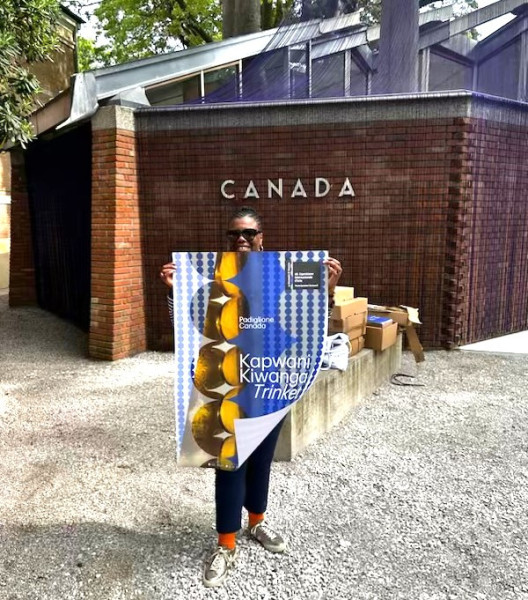
“It was just such an honor,” Verna said. “To work with this artist at this moment in time and to imagine a project this complex and challenging and then bring it out to the world, we hoped people would get it and be interested in it and love the poetry of what we tried to do together.”
Their collaboration produced “Trinket,” an exhibition built around thousands of “conterie,” or Venetian seed beads.
“[At the height of Venice’s merchant power], no explorer, no missionary, no adventurer would leave Europe without beads to trade in all parts of the world – North America, South America, Africa, India. This was currency,” Verna explained.
Strings of beads were installed throughout Canada’s pavilion. In addition to the conterie, the exhibition included palm oil, gold, silver, wood among other materials. The integration of these materials within the artwork were Kiwanga’s way of evoking the exchange and the value associated with cost of trade.
“When we start talking about trade and all of its many forms, there is violence,” Verna said. “These are the worst stories. As an artist, sometimes you don’t need to say things to speak to them. That’s what I really like about this project.”
Verna and Kiwanga have collaborated before, most recently at the Wexner Center. As curator, Verna saw herself as Kiwanga’s primary supporter. After all, she said, a lot of the pressure of any exhibition project falls on the artist.
“I know who bears the most responsibility for an arts project. It’s the artist,” she said. “I am here to champion, to be a thought partner, to push, to research, to write, to be a bridge between the work and vision of the artist and the final project, to work together on every aspects of the exhibition. We must support the artist in every area so they can confidently realize their project to its fullest.”
Curating Canada’s pavilion gave Verna the chance to represent not just her home nation but her employer as well.
“Ohio State is known internationally,” she said. “We have a Nobel laureate. We function on the global stage. How great to have, through the Wexner Center for the Arts and its enduring capacity, another way to engage with the world.”
Verna made sure to mention Columbus whenever she could.
“Every time I was given the opportunity of speaking, I mentioned that I am the executive director of the Wexner Center for the Arts at The Ohio State University. It was important for me to leverage this opportunity as a spokesperson.”
Simultaneously curating an exhibition and running a world-class art center made for long hours here and there, she said.
“My first responsibility is to the Wexner Center,” she said. “Everyone on both teams was amazing. We figured it out. And I’d tell myself, ‘We can sleep when we’re done.’”
The experience was remarkable, Verna said. She looks forward to returning to Venice this summer to explore more exhibitions. Just as the city once served as an international trade hub, it now pulses with ideas from around the world.
“We can think of trade as a beautiful thing,” she said. “But those stories also are filled with horrors. What is our responsibility in this? Can we see a better-shared future through works of art?”
