

Labor secretary tours Ohio State’s advanced manufacturing center
Technology projects support U.S. competitiveness, prep students for workforce
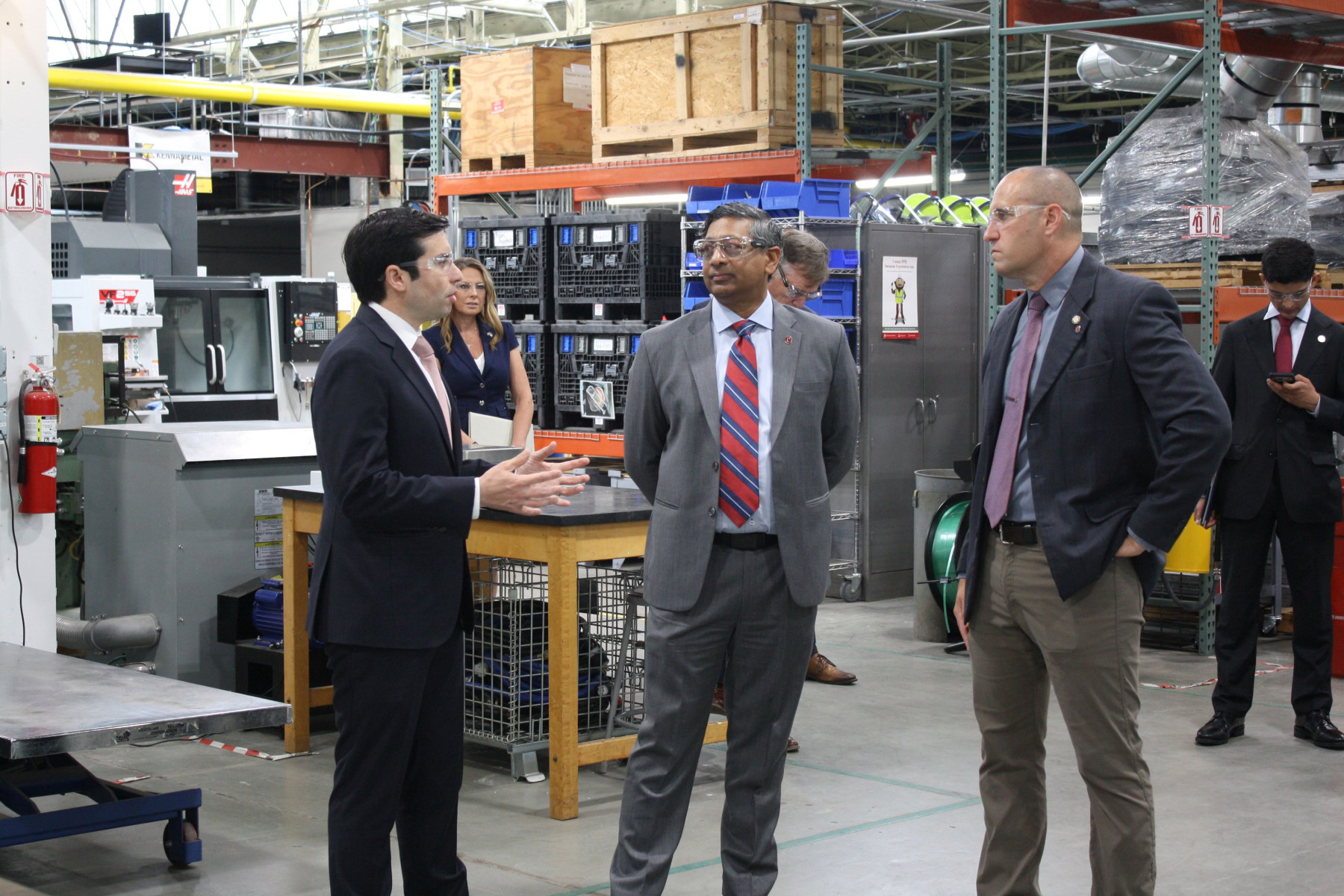
Acting U.S. Secretary of Labor Keith Sonderling visited The Ohio State University’s Center for Design and Manufacturing Excellence (CDME) Monday to tour the facility and learn more about how the university is advancing research in advanced manufacturing and preparing students for the workforce.
Sonderling joined Ohio State President Ravi V. Bellamkonda, Vice President for Research John M. Horack, CDME Executive Director Nate Ames and other university representatives on the tour.
CDME students showed off tools for metal printing, digital design and simulation software, and advanced welding.
The tour concluded in the center’s Artificially Intelligent Manufacturing Systems (AIMS) Lab, where industry professionals, undergraduate students and researchers work together to study and develop manufacturing systems that work with, and are controlled by, different types of artificial intelligence.
“We have a unique place at Ohio State where we do workforce development, but we disguise it as technology translation,” Ames said. “We use industry programs as a way to lift up the students to ensure they’re ready to work immediately upon graduation.”
CDME works with companies and researchers to translate new technologies into real-world, market-ready manufactured products. These projects give student employees at CDME hands-on experience in integrating new technology while providing customers with the workforce advantage necessary to compete in a global marketplace.
CDME partners with more than 150 companies and has completed over 900 applied engineering projects. The center houses more than $20 million in industrial-scale equipment and employs 40 full-time technical staff and 150 undergraduate students.
“Most of the students who work in the center have a job years before they graduate. While they're working here, they’re working for the companies that ultimately want to hire them,” Ames said. “So, it’s effectively a four-year interview for both.”
