

Ohio State a ‘thought leader’ at global congress
Age-Friendly Innovation Center team traveled to Spain for World Health Organization event

|
Franny Lazarus Ohio State News |
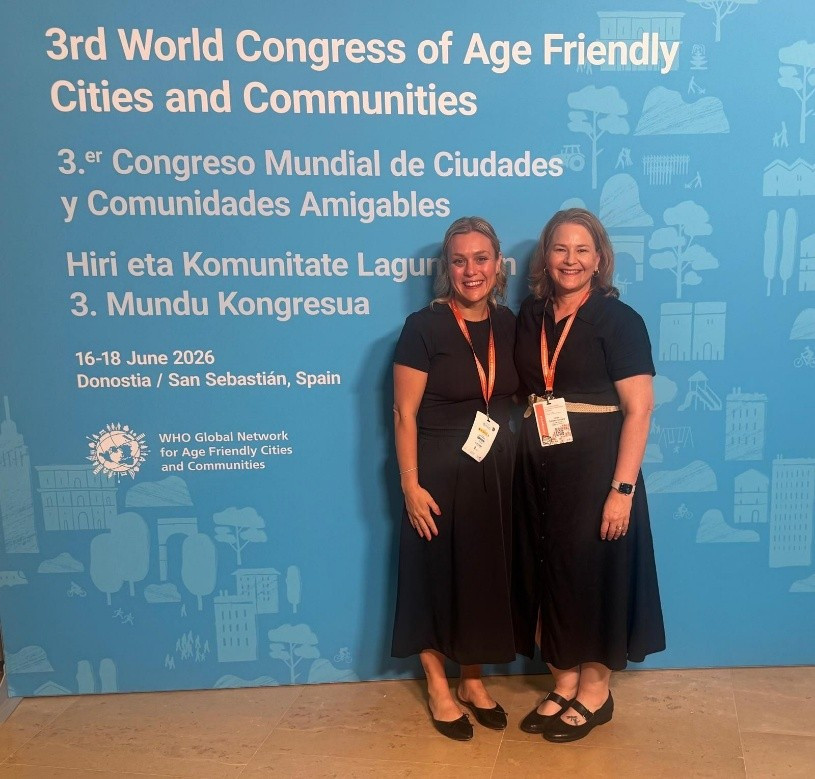
Over the summer, representatives from more than 1,700 cities around the world gathered in San Sebastián, Spain, for the World Health Organization’s (WHO) 3rd World Congress of Age-Friendly Cities and Communities. Among those participants were three people from the Age-Friendly Innovation Center (AFIC) at The Ohio State University.
“It felt very special to be part of such a large network across the globe,” said AFIC director Marisa Sheldon, “and to recognize that there are people working towards these same goals in 60+ countries.”
In 2007, WHO created the Global Age-Friendly Cities Guide. Cities identified as age-friendly work to strength their community in eight categories – including housing, transportation and social participation – chosen by older people, caregivers and service providers. Columbus joined the AFIC network in 2016, through the support of Mayor Andrew J. Ginther.
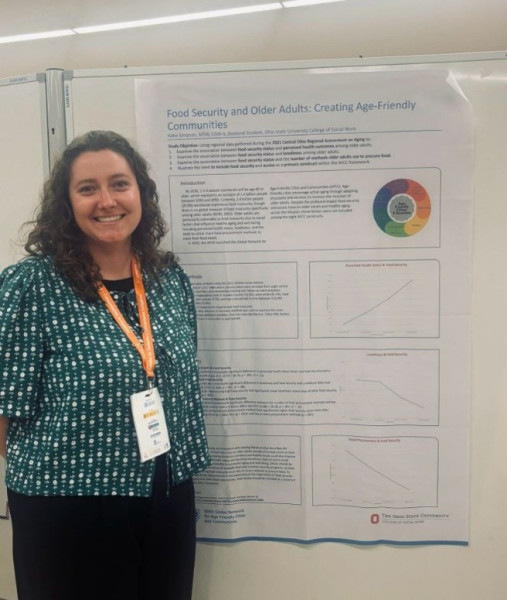
Sheldon was joined by Holly Dabelko-Schoeny, professor in the College of Social Work, and Katie Simpson, a doctoral student in the college. For Simpson, the experience was both exciting and overwhelming.
“Being on the global stage as a doctoral student, seeing all those career researchers,” she said, “I’ve read their papers, I’ve cited their papers, I’ve looked at their work. That’s what I want to be when I grow up and all of a sudden, we’re in a room together.”
Simpson presented research on food insecurity and its relevance to WHO’s guide. Food insecurity is not currently one of the eight domains that WHO considers for age-friendly communities, Dabelko-Schoeny said. Simpson’s research will help guide future initiatives.
“I was really proud of the fact that one of our doctoral students is a thought leader around what kinds of changes need to occur in the framework. While there hasn’t been a lot of talk about food insecurity previously, the talk at the congress was led by Katie. It is exciting for Ohio State and for the College of Social Work.”
Simpson wasn’t the only Ohio State attendee making waves. Dabelko-Schoeny was part of a team mapping all the existing interventions under the age-friendly framework, Sheldon said. The only U.S.-based researcher on the project, Dabelko-Schoeny reported the group’s findings at the multiday event.
“The invitation to the congress came from WHO because of the work that we do at AFIC,” Dabelko-Schoeny said. “I was so honored to be invited to the table with this international group of scholars to map out our existing evidence in this space.”
“Real age-friendly transformation happens when older people, their communities, policymakers and researchers coproduce the future together,” said Thiago Hérick de Sá, who oversees age-friendly environments for WHO. “The Age-Friendly Innovation Center at The Ohio State University stands as a leading example, not just working to fulfill that vision but also willing to share their experience internationally, as we witnessed during the 3rd World Congress of Age-Friendly Cities and Communities in Spain this year.”
Meeting so many international peers was an extraordinary experience, Sheldon said.
“I often say that in our work, I don’t always know what the next step is when I meet a partner, but I’m glad I know you now so when that step arises, we have a relationship,” she said. “There was a lot of sharing and requests for follow-up. To have these networks across the country and across the globe is so powerful as we think about the future of our work.”
“That old saying, ‘We are better together,’ is really true,” Dabelko-Schoeny said. “To be at the table as a U.S. representative, as an Ohio State representative, it’s the collective that allows that to happen.”
On the world stage, an organization like AFIC has credibility because of its affiliation with a research powerhouse like Ohio State.
“We are known for having evidence-informed tools that can be used in the community,” Dabelko-Schoeny said. “The work we do is always with an eye for dissemination to older residents, practitioners, policymakers. We want to infuse our scientific understanding with engagement from our older adults, our ‘experience experts.’”
“Being in the College of Social Work at Ohio State allows local, grassroots work to happen,” Sheldon said. “Through the grounding of an institution that is well-respected, well-connected and does things in a rigorous way, we can build knowledge from what happens here.
“We’ve been doing this work for quite a long time now,” she added. “It’s exciting to see the vision come together. Being at Ohio State, the relationships, the work, the respect, the publications, it makes sense.”
