

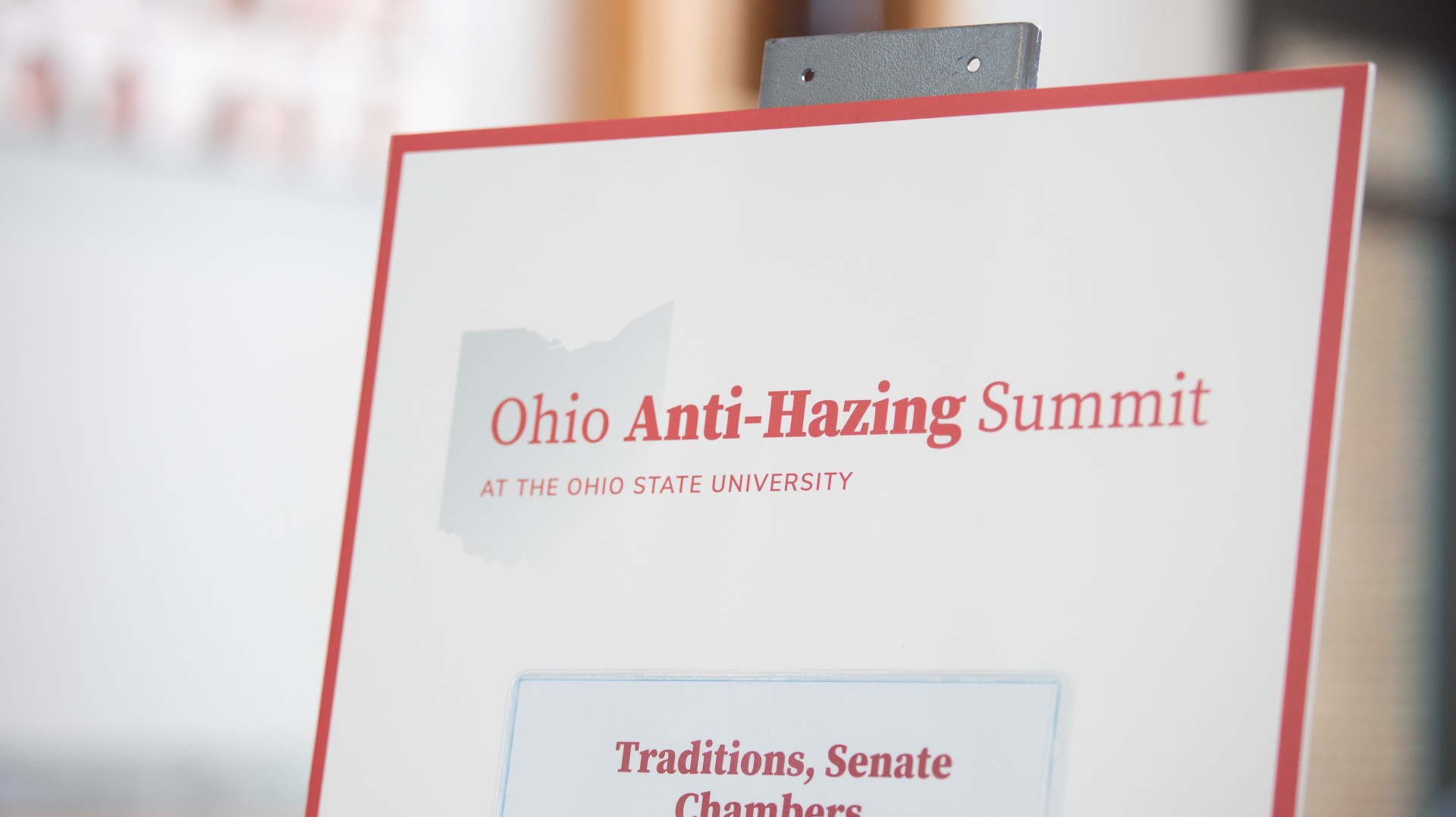
Ohio State hosts fourth Ohio Anti-Hazing Summit
Experts across disciplines and institutions seek solutions to complex issue

|
Franny Lazarus Ohio State News |
Hazing is a problem that institutions of all kinds face – sports teams, club organizations, workplaces and more. For the fourth year, higher education representatives from around the country came to The Ohio State University to seek solutions for hazing at colleges and universities.
The Ohio Anti-Hazing Summit welcomed 33 schools from Ohio, 10 national fraternity and sorority organizations, five national hazing prevention groups and eight schools from the Big Ten, as well as four vendor and consulting organizations, one Big 12 school and one Atlantic Coast Conference institution. 100 attendees were first-time participants. The summit began at Bowling Green State University four years ago.
Melissa Shivers, senior vice president for Student Life, kicked off the event by talking about her membership in a Greek-lettered organization.
“As a member of Alpha Kappa Alpha, I am always a supporter of the sorority and fraternity community,” she said. “I believe in what we do. Yet we still have a ways to go, to continue working with our organizations to ensure that they understand that there are meaningful, important ways of bringing new members into our organizations without putting people’s lives and health at risk.”
Ohio State has a robust hazing prevention program, offering risk reduction consultations and workshops, anti-hazing education for students and employees, and participation in National Hazing Prevention Week each fall.
The day was packed with events, including workshops meant to foster collaboration and education sessions on topics ranging from hazing investigations and athletic hazing to fraternity and sorority mentoring relationships and alcohol.
The first workshop was led by facilitator Mike McRee of the Whitespace Group. McRee, who experienced hazing himself, encouraged the audience to focus on solutions, not problems.
“Instead of being a naysayer, remember we’re going to be solution-oriented today,” he said. “We’re going to be thinking about those because everybody can identify problems. [So ask] how could this work? How could you take a concept and say ‘Yes, and what if we did this?’”
Small groups discussed opportunities that could be leveraged to prevent hazing.
Ben Batey, senior chief community and well-being officer and hazing prevention coordinator at Bowling Green, pitched the idea of “shared hardship” to his group.
“I get asked a lot, ‘What can we do in place of hazing?’” he said. “Particularly with our young men, they’re looking for shared hardship, something where they can tell stories after. I tell them, ‘Go do an obstacle course, a Spartan Race, a Tough Mudder – some kind of school-sanctioned event. You can get a group together and still have that experience.’”
As the first session wound down, groups were encouraged to write their best ideas on colorful sticky notes so others could see them. This type of collaboration was McRee’s goal.
“How can we partner across different departments, different organizations and beyond our own institution?” he said. “A statewide event like this is where we can network, connect and learn best practices. There’s a lot of subject matter expertise and content in this room. Some people have already found effective solutions and we’re going to generate more.”
