

Ohio State, Metro Schools expand Agriscience Futures Academy
Program promotes STEM education through agriculture

|
Chris Bournea Ohio State News |
The Metro Schools, which was founded through a partnership with The Ohio State University, is expanding its new Agriscience Futures Academy. The program promotes STEM education (science, technology, engineering and math) through the study of agriculture among middle and high school students.
The Metro Early College High School was established in 2006 through a partnership between Ohio State and Battelle, to create a school focused on STEM. The high school and Metro Early College Middle School, which opened in 2013, were originally located at 1929 Kenny Road on Ohio State’s Columbus campus.
 The Metro Schools moved to a new location earlier this year at 420 E. 19th Ave. and is continuing its relationship with Ohio State. The Agriscience Futures Academy is a partnership between Ohio State’s College of Food, Agricultural, and Environmental Sciences, the Metro Early College Middle School, the PAST Foundation and the Mezzacello Urban Farm.
Metro Middle School’s mission is to close learning gaps among ninth graders prior to high school enrollment, said Metro Middle School Principal Marc Sterner. The Agriscience Futures Academy furthers that mission by cultivating a passion for STEM education, especially among students who have had little interaction with agriculture, he said.
“We’ve got kids who live in the city, who have never seen agriculture programs or a cornfield,” he said. “We’re going to equip them with the skills they need to be able to enter a career in the agricultural field and figure out how to feed the world in 20, 50, 60 years.”
A greenhouse is under construction at the Metro Schools’ new building, which is the former site of Indianola Middle School. The greenhouse will give teachers additional space to teach STEM-related agricultural lessons, Sterner said.
“Last year, the kids grew their own kale and made kale chips,” he said. “The kids came up with recipes and seasoning to make Taki-flavored kale chips. They absolutely loved it, and we joked, we’ve got kids eating kale – wow!”
To further stimulate students’ interest in STEM, over the past year teachers began discussing how the food that students see on their plates is a result of agricultural science, said Debra Juracich, Metro Middle School science educator. The classroom conversations led to the development of the Agriscience Futures Academy.
“Every culture has food. It doesn’t matter where you come from, food is a central part of your life. So with that, we started talking about, ‘where does your food come from?’ ” she said.
“That’s how the idea came about: Why don’t we start having an agricultural focus and teaching science through an agricultural lens? Everything we do, we tie it into an agricultural standard.”
The Agriscience Futures Academy also teaches students how environmental factors affect agriculture.
“One of our natural resources is soil. We’ve been doing some soil analysis” with the students, Juracich said. “They’re learning how to determine soil composition with the soil triangle [tool]. They’re very curious and they ask great questions, and they’re making connections with the real world.”
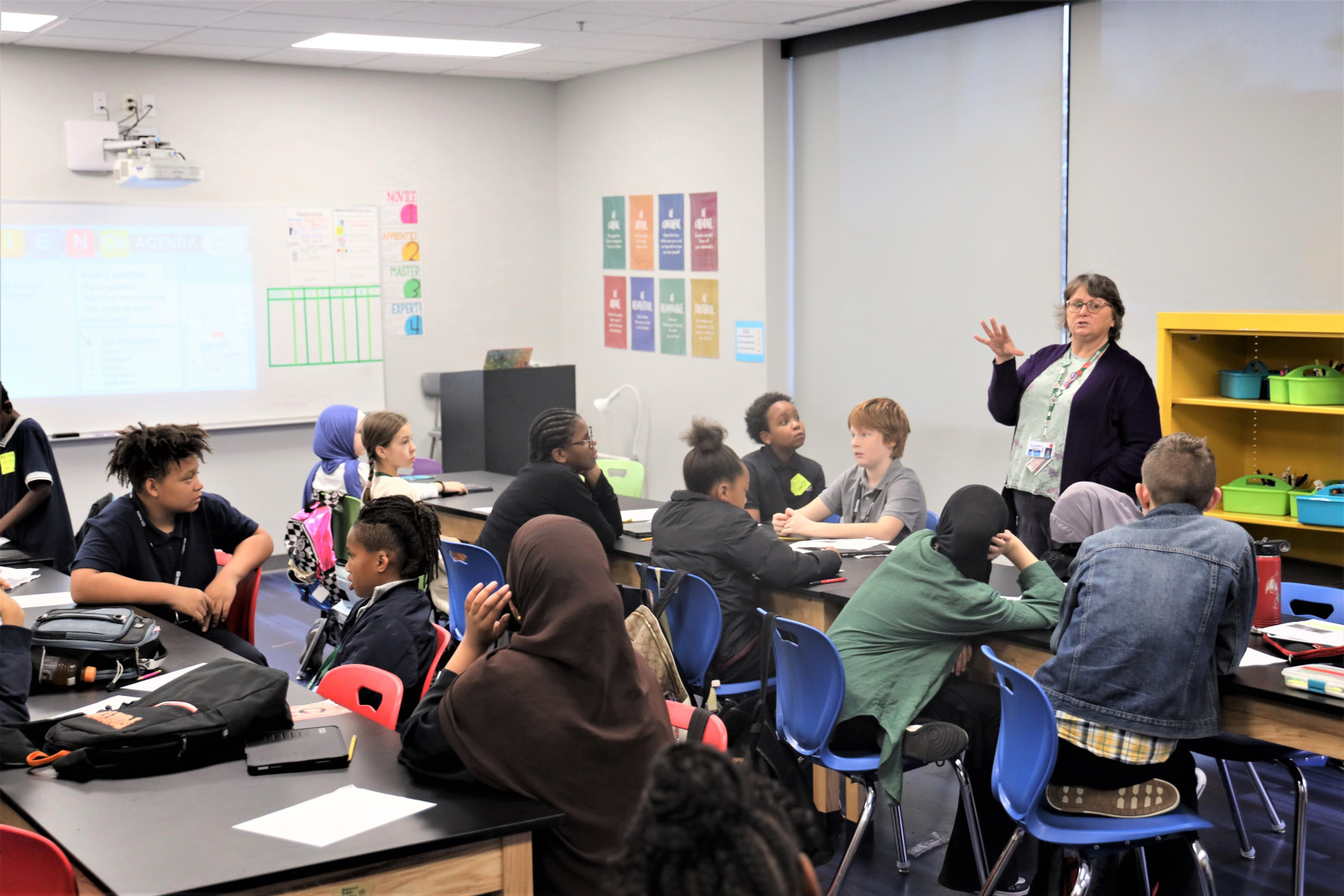
In one recent middle school class activity, students worked in small groups to analyze ice core samples. The lesson’s objective was to help students gain an understanding of how thawing glaciers in other parts of the world may affect Ohio’s climate and crops produced in the region.
“We’re learning about how you can tell what has happened over the years and you can tell how old the ice has been,” said Claire Michalak, a student in Juracich’s class. “You dig into the ice and then you pull it out and each black and white line represents the year.”
The students also learned how ice and snow, especially when they form glaciers, can absorb the sun’s rays.
“Without it, basically the sun can hurt us,” said Manal Atassi, also a student in Juracich’s class. “A lot of [snowy environments] are melting. Animals live there. It’s their habitat, too.”
Another recent lesson focused on how animals contribute to agriculture. Students interacted with rabbits and chickens from Mezzacello Urban Farm.
“We did an animal health and safety lab one day. There were kids holding rabbits, holding chickens that had never seen livestock,” Sterner said. “You bring in rabbits and chickens, and all of a sudden everyone’s totally engaged.”
The Metro Schools is opening a new elementary school at the 1929 Kenny Road location. The elementary, middle and high schools are accepting enrollments for the 2025-26 school year. For more information, visit the school’s website.
