

Ohio State students, faculty present research innovations
Forum brings together researchers from a variety of disciplines

|
Chris Bournea Ohio State News |
Students and faculty at The Ohio State University showcased work across a variety of disciplines during the College of Education and Human Ecology’s (EHE) annual Research Forum. EHE recently presented the event at the Ohio Union.
The forum included presentations throughout the day and a keynote address by Penny Pasque, professor of educational studies. The event concluded with EHE’s annual Legacy Lecture, featuring professor emeriti Evelyn Freeman and Bruce Kimball.
Pasque offered expertise to students and faculty who are starting their careers. She emphasized the importance of furthering Ohio State’s land-grant mission by engaging the communities that the university serves.
 Community engagement involves “making sure you’re looking for research questions from the community, but also community-involved work or community-directed work,” she said.
“Are you, through your work, paying community organizers to do interviews in the community and be a part of your research team? Or is it you and a research team going in and doing work and then leaving? Thinking about these things makes a difference.”
Among the presenters were Traci Lepicki, associate director of operations and strategic initiatives at Ohio State’s Center on Education and Training for Employment (CETE), and Elizabeth Kazemi, a graduate research associate. Lepicki and Kazemi spoke about their review of CETE’s Developing a Curriculum (DACUM) International Training Institute.
DACUM assists organizations in developing performance assessments for job duties in various industries. In their research, Lepicki and Kazemi survey industry representatives on how to keep DACUM’s tools up to date.
“Working with subject matter experts helps to ensure that DACUM is job-relevant, rather than a model that relies on some conceptual understanding or maybe an out-of-date approach,” Lepicki said. “DACUM is pulling from the people who are doing the work today so that they can provide [insight into], ‘This is how I learned it, but this is how I do it.’ We want to make sure training programs are built around the ‘this is how I do it’ approach.”
Kazemi said she approached CETE about working with DACUM because the research aligns with her professional background in human resources. She said the research offers insight into how higher education and industry experts can collaborate on workforce development.
“I’ve gotten two master’s [degrees] here and now my PhD” in workforce development at Ohio State, she said. “I recognize that Ohio State is at the forefront of bridging that gap and CETE is a cornerstone of that when it comes to workforce development and blending academia.”
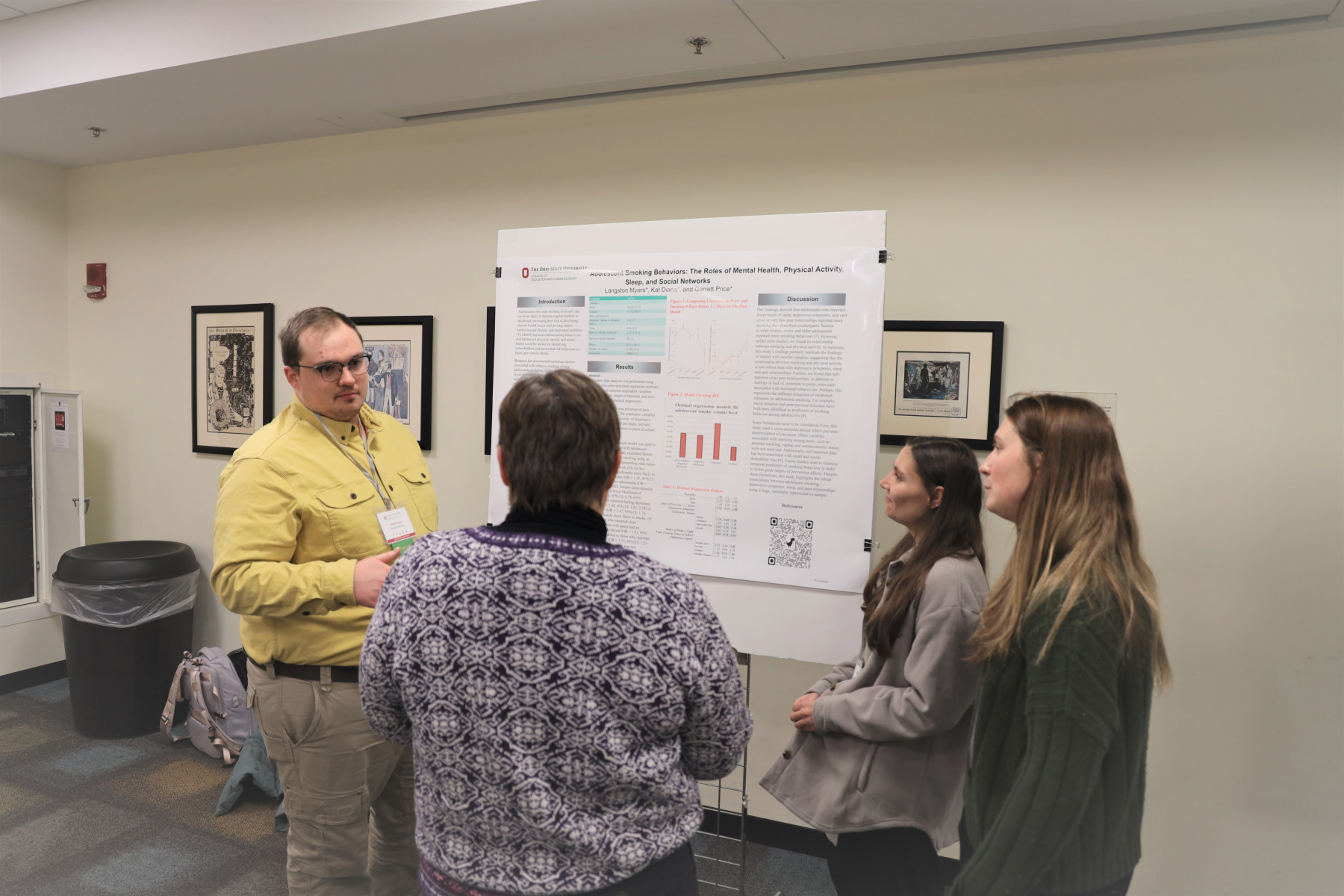
The Research Forum also included a session where graduate students displayed posters about their research and fielded questions from attendees.
Arushi Paul, Yvonne Gong, Ciera Fankhauser and Xin Feng presented research on how mothers cope with anger and depression. The research found that while some study participants self-medicated with alcohol or relied on prescription drugs to manage stress, others sought out therapy and other support systems, Paul said.
“If they didn’t have a therapist, they used their partners or friends as people they could turn to,” said Paul, a psychology major.
Langston Myers, Kat Diana and Garrett Price gave an overview of their research into how adolescent smoking is linked to mental health, physical activity, sleep and social networks.
“A lot of times, the exercise and the sleep and the depressive symptoms are all lumped together,” said Price, a graduate fellow in human development and family science. “Is isolation enough to lead [teenagers] to smoking?”
During the Legacy Lecture, Freeman and Kimball spoke about how Ohio State helped them pursue academic research that has made a positive impact on society.
Freeman taught courses in children’s literature and language arts, prepared elementary teachers and worked with graduate students. She retired as dean of Ohio State Mansfield.
Kimball served as director of Ohio State’s School of Educational Policy and Leadership. He later became a professor in the Philosophy and History of Education program.
Freeman and Kimball encouraged students and faculty to follow their passions.
“You have to follow your intrinsic interest,” Kimball said. “If you feel something is interesting to you, it’s going to feel that way to other people. … You don’t need to worry about going into the hot field at the time or chasing the funding.”
“It’s really important for people who are going into higher education to find joy in what they’re doing,” Freeman said, “to care about what they’re doing and to believe in it.”
