

Ohio State training helps military officials prepare for Middle East deployments
Virtual training featured former U.S. ambassador, Bronze Star recipient

|
Chris Bournea Ohio State News |
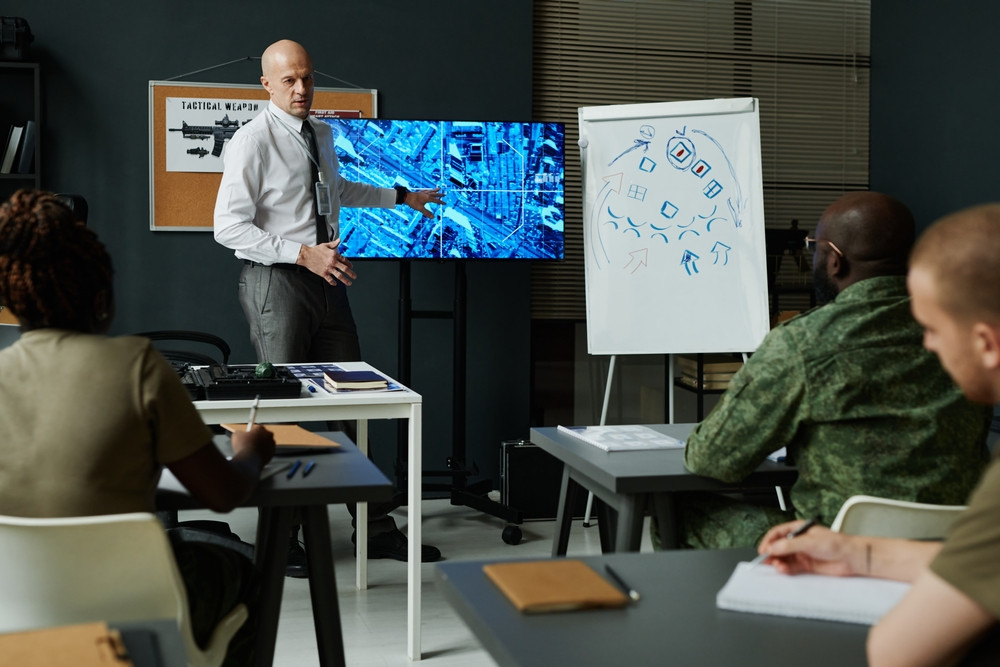
To assist U.S. military civil affairs professionals in deepening their understanding of the Middle East’s culture and customs before deployment, The Ohio State University recently hosted a virtual training session featuring presentations from retired military personnel, a retired U.S. Department of State ambassador and international academic researchers.
Ohio State’s Center for International Business Education and Research (CIBER), located within the Fisher College of Business, and the Middle East Studies Center presented the training.
Civil affairs personnel act as liaisons between the U.S. military and civilian authorities and citizens around the world. They work with communities to increase stability in the region, support local governments and improve the quality of life for civilians.
The training was geared to help civil affairs personnel enhance their understanding of the economic, political and cultural factors that drive current developments, said Emily Salopeck, CIBER global business operations senior analyst.
“We hope the sessions give you practical tools and perspectives to support your work in civil affairs,” she told participants.
The training was designed to provide context to complex political and social customs that civil affairs personnel may encounter when stationed in the Middle East, said Joy McCorriston, director of the Middle East Studies Center.
“Our reason for existing is to foster the next generation of experts, security and diplomatic experts, educators, international partners, civic leaders and informed civilians,” she said. “We’re eager to share our resources in projects like this.”
Speakers included Melinda McClimans, assistant director of the Middle East Studies Center; Deborah Jones, retired U.S. Department of State ambassador; and David Des Roches, a retired U.S. Army colonel who commanded the 450th Civil Affairs Battalion (Airborne) and was awarded the Bronze Star for his service in Afghanistan.
McClimans presented an overview of how the economy and culture of Middle Eastern countries have changed in recent years. Cultural norms, gender roles and other aspects of contemporary life vary throughout the region and often contrast with commonly held misconceptions, she said.
“It’s good to go beneath the surface,” she said, “beyond just what we’re seeing and to try to understand the underlying experiences and changes.”
Des Roches is now a professor of practice at the National Defense University’s Near East South Asia Center for Strategic Studies. He specializes in Gulf regional security, defense policy and emerging trends in the Arabian Peninsula.
Des Roches spoke about how military conflict has evolved in the Middle East over the past few decades. With warfare in the region increasingly involving players who are not part of officially sanctioned military units, the role of U.S. civil affairs professionals is more important than ever, he said.
“What we see is the capability inherent in civil affairs, particularly in … resource control, establishing law and government systems, and establishing justice systems,” he said. “Those are the decisive elements for the United States.”
Other speakers included Clemens Chay, a research fellow at the National University of Singapore’s Middle East Institute. He spoke about the importance of learning local councils’ tribal customs and etiquette to access information about their communities.
Amr Al-Azm, a professor of Middle East history and anthropology at Shawnee State University, outlined strategies to prevent antiquities from being looted and weaponized.
U.S. Army Staff Sgt. Sam Packer said the training provided information that will benefit him in an upcoming deployment.
“The instruction and topics were highly relevant to our interest and mission,” he said. “The event was well planned, well executed, thoughtful, collaborative and fostered communication and understanding.”
