

Stories, strategies and science steer Ohio State leadership conference
Inaugural event brought professionals together to discuss principled leadership

|
The Ohio State University Max M. Fisher College of Business |
Four years ago, Stephanie Matthews went from working as a professional photographer and creative producer to executive director of the Columbus-based nonprofit A Tribe for Jazz. The organization works to advance the legacy of jazz through community programs, education and special events.
“It took some time, but I’ve found the work that truly aligns with my purpose,” she said. “Creative leadership is what I’m meant to do.”
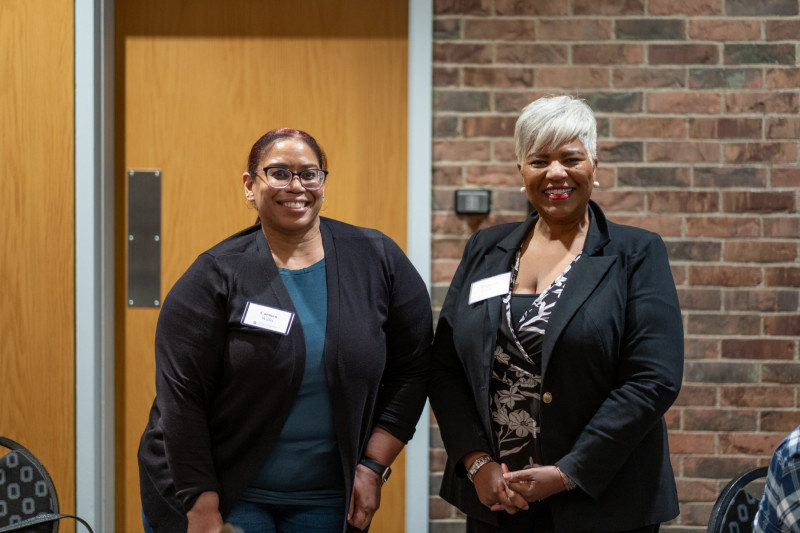 Matthews said her enthusiasm to lead thoughtfully brought her to The Ohio State University Fisher College of Business’ inaugural Conference on Principled Leadership. Held in partnership with the Fisher Leadership Initiative (FLI), the event brought together more than 200 professionals at the Fawcett Center in May for a daylong event featuring keynote presentations, panel discussions and analysis of a science-based assessment of attendees’ leadership skills.
Matthews attended with friends Carmen Willis, an Ohio State alumna and incident manager for JPMorganChase, and Yashmine Boston, an information technology change manager for Chase. They were joined at their table by Reynoldsburg Mayor Joseph Begeny and other professionals who took a deeper dive into the traits, responsibilities and impact of values-driven leaders.
Before the event, conference attendees completed FLI’s Principled Leadership Assessment.
Ben Tepper, professor of management and human resources and FLI executive director, and Hun Lee, associate professor of management and human resources and FLI director of research, developed the assessment to measure behaviors that distinguish principled leaders.
Tepper and Lee told the audience that the assessment can offer insight into a leader’s strengths and areas for growth as they relate to four core dimensions of principled leadership: moral attentiveness, flexibility, sustainability and responsibility.
“We wanted to measure to see if principled leadership matters or is valuable,” said Lee. “We found that it is.”
FLI’s initial research revealed that principled leaders more often inspired their teams to create new ideas and establish goals, improved their company’s sustainability and succession and saw reduced conflict among their teams.
Conference presenters and panelists also addressed many of the core dimensions of principled leadership, offering ideas and solutions for creating efficient and value-centered work environments.
“It’s always helpful to have a different lens,” said Eric Schumacher, director of the Division of Hospital Medicine, Department of Internal Medicine at Ohio State Wexner Medical Center. He said the assessment accurately captured his leadership style and offered valuable insights.
Schumacher and 10 members of his leadership cabinet used the conference as their quarterly retreat. The group shared notes and nuggets of inspiration from the day’s speakers over WhatsApp.
Other participants shared similar experiences and challenges in a panel discussion about courage and responsibility moderated by John Hrusovsky, managing director of Synexis Consulting; Eric Lenard, vice president for Johnson & Johnson’s Global Services Finance; Jo Ann Quinif, president and chief client officer for Diamond Hill; and Parag Shah, chief ethics officer at Nationwide.
The panelists talked about situations in which they, as leaders, faced challenges and uncharted territory. They not only explored what it means to be courageous leaders, but ethical leaders, a theme that continued throughout the conference.
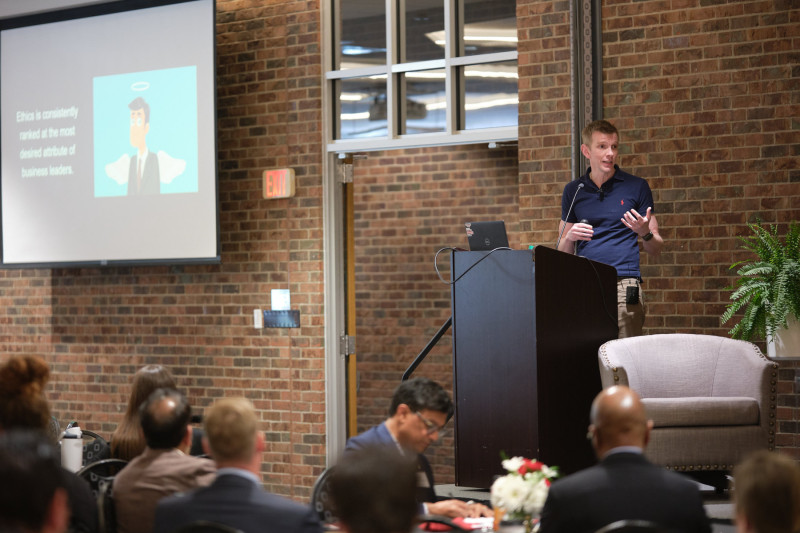 Angus Fletcher, Ohio State professor of story science, engaged participants in a lively discussion about ethics, the impact of moral injury in business and the importance of personal narratives in forming principled leaders.
While some believe you can develop character by sharing stories about “good people” and asking leaders to emulate those people, research has found that highly effective people spend more time reflecting on their narrative, said Fletcher, who received the U.S. Army’s Public Service Commendation medal for training special operations personnel in leadership.
“The story that is most important is your story,” he said. “We need to shift focus and encourage people to reflect on their own story, so they start to develop their own character from within.”
He engaged conference participants in an exercise about stories by having them recall a time when they were proud of how they acted and then asked them to share that story with others around their table.
“When people are faced with moral challenges, they immediately remember other times when they were faced with moral challenges,” he said. “The more you come up with those, the more you build your moral integrity.”
The conference concluded with a panel discussion about sustaining principled leadership moderated by Raj Ramachandran, senior partner, leadership advisory at WittKieffer.
The panel included Corrine Burger, recently retired managing director for JPMorganChase; Jimmy Reid, executive vice president, head of workplace solutions at Lincoln Financial Group; and Jerome Revish, senior vice president/chief technology officer at Cardinal Health.
Matthews said she appreciated the conversations about principled leadership and attention to science-inspired ideas at the conference.
“Gaining insight into what’s happening in the brain and body — and how small adjustments can make us stronger, more effective leaders — was incredibly powerful,” said Matthews. “It exceeded my expectations.”
