

Student veterans bring beekeeping program to the campus prairie
Bee enthusiasts hope to grow colony and honey production

|
Wayne Rowe Ohio State News contributor |
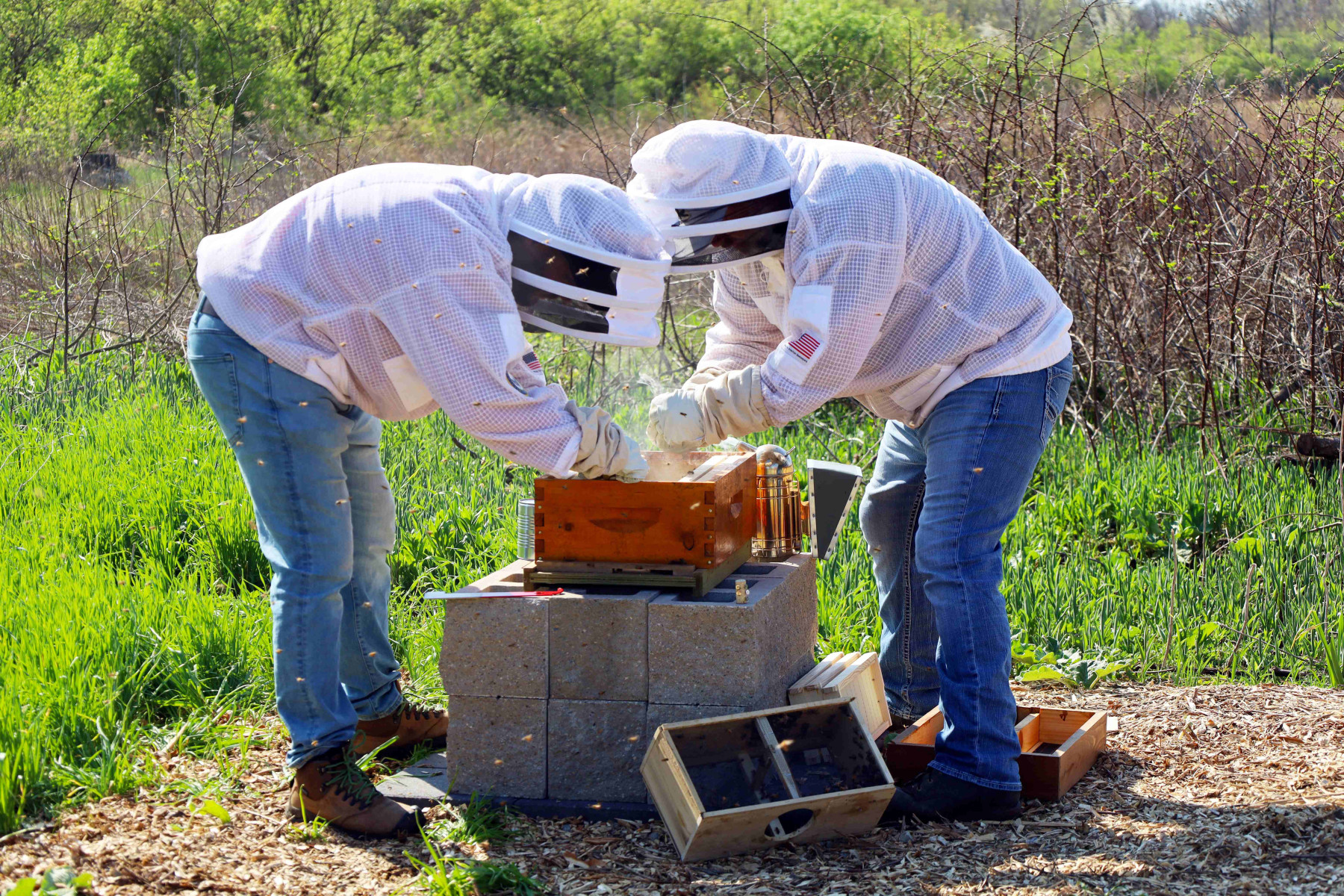
Two Marine veterans studying at The Ohio State University at Marion are making their mark on sustainability efforts and the campus community by introducing beehives to the Larry R. Yoder Prairie Learning Laboratory, an 11-acre Sandusky Plains tall grass restoration project that began on the campus in 1977.
After attending the Central Ohio Beekeepers Association (COBA) Veteran Beekeeping School together, Todd Lee, a junior social work major from Delaware, Ohio, and Eric Bailey, an engineering technology major from Columbus, brought their joint vision together by delivering two hives to the campus prairie at the end of spring semester.
According to Bailey, the idea of bringing beehives to the campus prairie began with organizing an outreach event with COBA at Ohio State Marion.
“We had Bob and Claudia Bowers from the Central Ohio Beekeepers charitable foundation come to campus. We were just doing some outreach to try to get veterans to sign up for Veteran Beekeeping School this year,” said Bailey.
“Todd had brought up the idea of, why don't we have bees at the prairie? The idea kind of took off from there,” he added.
"I believe the bees serve multiple purposes,” Lee said. “As Eric explained, when I came up with the idea, my first thought was that it’s a fantastic concept because it encompasses so many different aspects. It benefits the ecological health of the prairie and contributes significantly to the overall goal of conserving it.
 “Eric and I both being Marine Corps veterans realized in the beekeeping school how much the bees really help veterans on various levels,” he said. “Each person faces unique struggles and challenges, and bees can impact these differently. For me, I can say that confronting and overcoming my fears gives me a sense of confidence. Once you realize that you can tackle something again, you begin to rebuild your confidence and boost your self-esteem. As a result, you also start to learn more about bees. There’s a real humanistic experience to this, and it makes the journey enjoyable.”
Lee feels the bee apiary will impact students and the campus in a host of positive ways and hopes this helps build the project to the point where it is ingrained as part of campus culture.
“Eric and I both work hard to communicate and promote the project to engage our campus community, including faculty, students and other veterans. Therefore, we hope to see this become a long-term initiative,” said Lee.
“We wanted to bring back the knowledge we had gained from the school that did so much for us and share it with others. It’s important for all of us to have a sense of service, and this project kind of gives us that.”
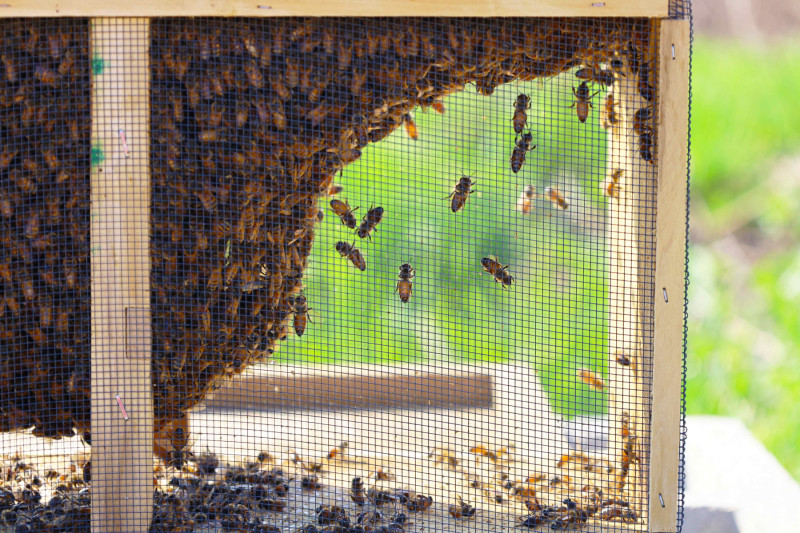
Bailey said each of the new hives has its own queen. The honeybee hives were commercially produced in Georgia and are now in place with the goal of growing the colony.
“There will be approximately 30,000 to 60,000 bees when they build up their colony. Right now, they’re going to release that queen and within the next couple of days we’ll come back and … feed them in the brood boxes. Then the queen will start laying eggs. From there they’ll build out the comb,” Bailey explained.
Once the bees build up about 80% of the comb another brood box will be added. Later in the season, they’ll start making honey for stores over the wintertime.
The two bee enthusiasts hope the growth of the colony and honey production can lead to additional commercial campus ventures.
“We both live in the area, but we want to be able to kind of transfer this thing over and get people involved in keeping it, and hopefully it catches on that way,” Bailey said.
Lee sees this as an outreach for veterans, even if they don’t attend Ohio State Marion.
“We want to incorporate as many veterans as possible who are interested in engaging with bees and learning about beekeeping. It’s something that we can use as a platform to help multiple people who may be struggling,” he said.
The two students hope the hives eventually produce honey that can be marketed and used to expand the program or other campus initiatives and made available at the food pantry at Ohio State Marion.
“It has been a great process working with Ohio State Marion and working with Bob and Claudia from COBA charitable foundation. They were supportive and helped get this all accomplished,” said Lee.
“We want to include the Veterans and Sustainability Club on campus, and we’ve mentioned it to the students,” said Bailey.
“The biggest goal is to incorporate veterans, sustainability and campus students. Without them,” Lee said, “it won’t have the same impact.”
Lee and Bailey see several connections with faculty incorporating the bee apiary into hands-on real-world study, especially with a biology major offered at Ohio State Marion and conservation being important to several people on campus.
Support for the project has come from the Central Ohio Beekeepers Association and its foundation, which hosts the school for veterans. Lee and Bailey agreed everyone involved in bringing the hives to Ohio State Marion has been supportive.
“We haven’t reached any real resistance from any angle. Everybody, the staff from Ohio State, COBA, everybody just like jumped in and said yeah, let’s do it,” Bailey said.
